The Republic for Which It Stands: The United States during Reconstruction and the Gilded Age, 1865-1896 (Oxford History of the United States) by Richard White
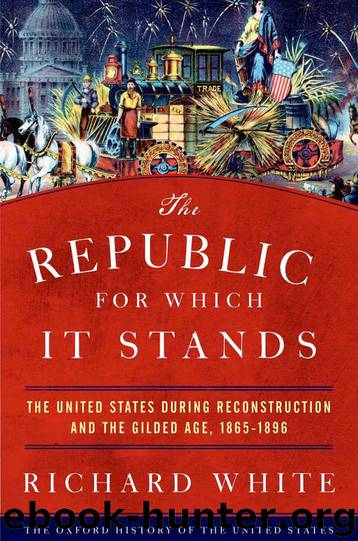
Author:Richard White [White, Richard]
Language: eng
Format: azw3, epub, mobi
ISBN: 9780190619077
Publisher: Oxford University Press
Published: 2017-08-04T04:00:00+00:00
The Chicago Tribune denounced the protests as communism.40
Hesing was a Republican and a bummer who would later go to jail in the Whiskey Ring scandal, but he spoke for his constituency. He and Irish American Democratic leaders formed an alliance in 1873, which toppled Medill and the reformers. They embraced an ethnic Chicago. Although corrupt and not necessarily averse to redistributing a certain amount of income upward, they protected ethnic voters who elected them from the evangelical Republican temperance reformers. They reclaimed the police force, which had under Medill increasingly become the domain of the native-born, and they handed out the small favors immigrants often needed to survive. Their triumph proved short-lived. Economic collapse and threats to the built environment trumped them. The Panic of 1873 and a second major fire on the South Side, which threatened the rebuilt downtown, recast Chicago’s politics and disrupted the bummers’ control. The second fire brought an extension of the fire limits, and CRAS refused to allow the city to dispense aid to help the unemployed. These policies drove workingmen beyond the existing city limits. Small wooden houses did not disappear; they just moved to the suburbs, along with many of Chicago’s industries.41
Political battles over housing easily morphed into fights over water and sewage. The business reformers wanted fire protection. This required a water system covering the entire city so that a fire could be stopped before it reached critical mass. They did not, however, want either urban debt or high taxes. The result in Chicago, and elsewhere, was a grand political accommodation. Liberalized city charters allowed cities to pay for public improvements through increases in bonded debt to finance the pumping stations, aqueducts, underground pipes, and sewers; in return business secured a legal limitation on the maximum size of the city’s municipal debt and taxes. As long as the politicians maintained low taxes, businessmen would not monitor the conduct of local government. The new system awkwardly grafted together a public interest solution—infrastructure covering the whole city—and a Jacksonian solution that maintained aspects of segmented governance. The city would charge individual users both significant hook-up fees to connect and then annual fees for water and sewage. These fees would pay the interest and debt on the bonds. This hybrid solution reduced the system’s efficacy since poorer residents often could not afford to connect, but it allowed the cities to build and expand.42
Chicago’s politicians accepted the compromise because the water system leaked water but gushed money. The city’s Department of Public Works, created in 1875, became the center of a so-called pump house gang. The fee structure produced revenues far above the cost of maintaining the system. Aldermen did not use the profits to provide universal access; instead they used it as a source of patronage jobs, and to create a special surplus fund. By 1883 the system was generating a surplus of $20 million; by the end of the decade the surplus had risen to $30 million. The profit ratio was immense, more than 400 percent by the 1890s.
Download
The Republic for Which It Stands: The United States during Reconstruction and the Gilded Age, 1865-1896 (Oxford History of the United States) by Richard White.epub
The Republic for Which It Stands: The United States during Reconstruction and the Gilded Age, 1865-1896 (Oxford History of the United States) by Richard White.mobi
This site does not store any files on its server. We only index and link to content provided by other sites. Please contact the content providers to delete copyright contents if any and email us, we'll remove relevant links or contents immediately.
| Africa | Americas |
| Arctic & Antarctica | Asia |
| Australia & Oceania | Europe |
| Middle East | Russia |
| United States | World |
| Ancient Civilizations | Military |
| Historical Study & Educational Resources |
Cat's cradle by Kurt Vonnegut(15468)
Pimp by Iceberg Slim(14713)
4 3 2 1: A Novel by Paul Auster(12544)
Underground: A Human History of the Worlds Beneath Our Feet by Will Hunt(12172)
The Radium Girls by Kate Moore(12120)
Wiseguy by Nicholas Pileggi(5874)
The Fire Next Time by James Baldwin(5538)
Perfect Rhythm by Jae(5498)
American History Stories, Volume III (Yesterday's Classics) by Pratt Mara L(5348)
Paper Towns by Green John(5265)
Pale Blue Dot by Carl Sagan(5098)
A Higher Loyalty: Truth, Lies, and Leadership by James Comey(5031)
The Doomsday Machine by Daniel Ellsberg(4578)
The Mayflower and the Pilgrims' New World by Nathaniel Philbrick(4569)
Killers of the Flower Moon: The Osage Murders and the Birth of the FBI by David Grann(4499)
The Sympathizer by Viet Thanh Nguyen(4463)
Too Much and Not the Mood by Durga Chew-Bose(4407)
The Borden Murders by Sarah Miller(4402)
Sticky Fingers by Joe Hagan(4268)
